

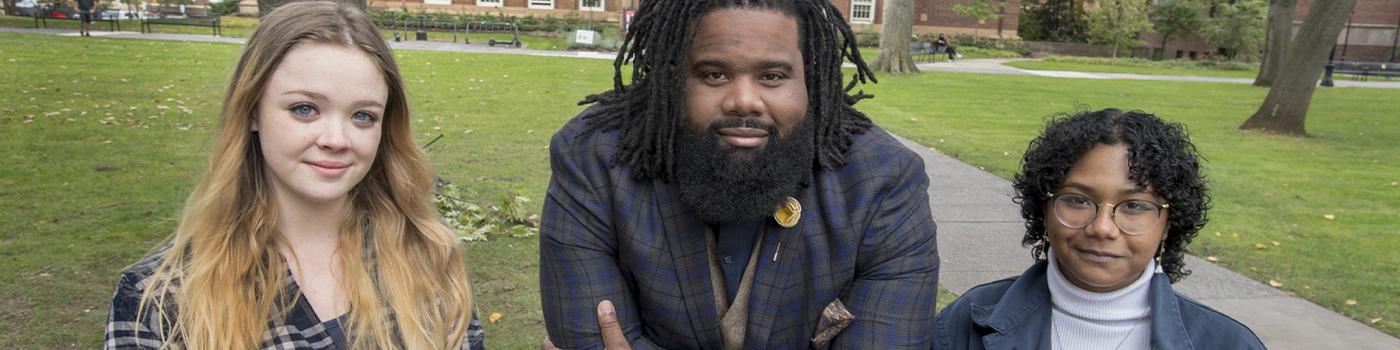
Fostering Inclusive and Brave Conversations
Diversity Peer Educators (DPEs) are Rutgers–New Brunswick students committed to educating their peers on topics of diversity, inclusion, and social justice. DPEs serve as a resource to students, provide workshops/educational sessions, and facilitate dialogue spaces. Session topics are tailored to educate students on identity development, race, class, gender, sexuality, abilities, and more. DPEs are trained to facilitate inclusive and brave conversations, and are an integral part of enhancing our student affairs commitment to building inclusive communities across the New Brunswick campus.
Diversity Peer Educators host several educational opportunities throughout the year, including:
- Training Programs
- Research, Scholarship, & Current Event Showcases
- Activism & Service Programs
- Conversation & Processing Spaces
- Passive Engagement (social media, web, etc)
- Ad-hoc Workshop Requests
Request a Diversity Peer Education Session
DPE Workshop Offerings
- America: An Indigenous & Native Land
This session examines the true history of the land we live on, centering Indigenous voices and experiences. Participants will gain a deeper understanding of colonization, land acknowledgment, and what it means to honor Indigenous sovereignty today.
- Disability & Ableism
This session encourages participants to grow an increased understanding of the people who identify as having a disability. Participants will be able to identify examples of ableism in social, medical, and systemic contexts, reflect on how ableism shows up in everyday language, behavior, and institutions, and strategize how to build more accessible and inclusive spaces.
- Diversity Across Faith, Spirituality, & Justice
The purpose of our Diversity Across Faith, Spirituality, & Justice session is to develop an understanding of how different faiths represent themselves worldwide, analyze how their experiences with religion have shaped their views on justice, and understand unjust experiences within faith communities.
- Diversity in Media
In this session, we will review the importance of diversity in movies, television, books, and other forms of media. We will discuss what it means to be more diverse, why diversity is important, and how to incorporate diversity respectfully.
- Gender in Society: Feminism
This session is an introductory conversation about feminism. It covers different nuances of the feminist movement and sheds light on its evolving nature. We will go over the history of feminism, different theories of feminism, and important national and global feminist movements.
- Gender in Society: Transphobia
This session provides a safe space to understand and confront transphobia in our communities. We will discuss how to be a better ally, the importance of using correct pronouns and names, and how to spot and challenge harmful stereotypes and policies to create a more inclusive environment for everyone.
- Immigration in America
This session has been developed as a direct response to the increase in harmful rhetoric that impacts the experiences of immigrants in America. Participants will learn about the history of immigration, the positive contributions that immigrants have made to American society and culture, and strategize ways to support immigrants during the current national climate.
- Mental Health & You
This session explores the importance of mental health and self-care, especially for students navigating stress, identity, and community pressures. Participants will learn practical strategies for maintaining emotional well-being and fostering supportive spaces for themselves and others.
- Police Brutality
This session was developed as a direct response to the increased instances of police brutality that directly harm communities of color and other marginalized communities. Participants will investigate specific instances of police brutality while having open and respectful dialogue about the history and potential future of the police force in America.
- Power & Privilege
This session explores how power and privilege shape individual experiences, relationships, and systems. Through discussion and interactive activities, participants will build awareness of social dynamics and develop tools to support equity and inclusion.
- Pronouns are Words, Too
This session explores what pronouns are, why they matter, and how using them respectfully helps create more inclusive communities. This interactive workshop explores pronoun diversity, common misconceptions, and practical ways to confidently share and use pronouns in everyday interactions.
- Race in America
This session will explore both the history and present-day impact of the role that race plays in the U.S. We will go over the differences between race, ethnicity, and what it means to be racialized. We will also discuss the impact of white supremacy and racism in institutions, systems, and other aspects of society.
- Racism in Leadership
This session encourages participants to reflect on, identify, and analyze how racism appears in interpersonal and institutional/systemic practices, especially in leadership settings. Participants will strategize ways to create more inclusive spaces and practice allyship in leadership roles.
- Courageous Conversations
This workshop is meant to be customized to the specific needs of your organization or team. Courageous Conversations provides a brave and protected space for students to engage in difficult dialogue across different perspectives while centering respect and the collective well-being of the community.
- CLARA: A Tool for Navigating Contentious Conversations
This hour-long workshop unpacks the CLARA (calm, listen, affirm, respond, add) method of communication as a tool for engaging in difficult conversations respectfully.
*DPEs are trained CLARA facilitators. Request a CLARA Training through the Tyler Clementi Center's request form: go.rutgers.edu/tccrequest
Contact Us
The Diversity Peer Educators program is coordinated through the Center for Social Justice Education & LGBT Communities.
If you have questions or inquiries, please contact Paolo Miyashiro Bedoya, Assistant Director of Education, at ru.dpe@rutgers.edu.
Follow the DPE Program on Instagram @rutgers_DPE.
Apply to be a Diversity Peer Educator
If you would like more information about the DPE program or the application process for the 2027 - 2028 academic year, please contact ru.dpe@rutgers.edu.
Eligibility
- Be a full-time Rutgers University–New Brunswick student
- Have a minimum cumulative grade point average (GPA) of 2.75
- Be in good academic and judicial standing at the time of application and for the duration of employment
Responsibilities
- Organize and execute at least three educational offerings per semester.
- Attend bi-weekly DPE meetings.
- Participate in social media campaigns and other passive educational opportunities.
- Be available for other duties as needed, such as open/drop-in hours, planning meetings, professional development sessions, and scheduled retreats
DPEs will utilize their training in basic facilitation skills to engage participants in brave conversations. They will guide debrief discussions on a chosen topic and challenge participants to take what they learned into their communities across campus.
Recruitment Timeline
- Applications for the 2027 - 2028 year will open towards the start of the spring 2027 semester.
- Applications close in late February.
- Interviews will occur between March and April of 2027.
- Decisions will be sent in late April 2027.
Upon selection, DPEs must complete online training modules over the summer before participating in a required in-person training retreat prior to the first week of school. The trainings are mandatory and consist of a series of activities, discussions, readings, and writings that will be used to expand the participants' knowledge about diversity from a historical and contemporary perspective. At the completion of the course, DPEs will work to develop programs for their respective functional areas.
Compensation
The annual stipend for 2026 - 2027 is currently $2,038, paid out biweekly at minimum wage throughout the fall and spring semesters.
Contact Us
The Diversity Peer Educators program is coordinated through the Center for Social Justice Education & LGBT Communities.
If you have questions or inquiries, please contact Paolo Miyashiro Bedoya, Assistant Director of Education, at ru.dpe@rutgers.edu.
Follow the DPE Program on Instagram @rutgers_DPE.

